
Most people read “rents are rising again” and assume landlords are back in charge. That’s half the story. Rents are rising — and so is the share of landlords quietly handing some of it back to get a lease signed. The number on the listing and the number that lands in the bank account are drifting apart, and that gap is where the useful decisions are.
Credit where it’s due: Garrett Brown, who writes BiggerPockets’ Investor Brief, took Zillow’s September Market Report and ran the math a landlord actually needs. It’s the kind of plain-English work that makes all of us better at this, and it deserves a local follow-up.
Here’s what the national numbers say, how Kitsap compares with the region and the state, and how to use it whether you own a rental, rent your home, or are underwriting your next one. This is educational context, not legal advice — Washington’s rental rules carry real penalties, so talk to an attorney before you change how you price or write a lease.
The national picture: rents up, sweeteners up too
Zillow’s typical U.S. rent was $1,932 in September, up 2.7% from a year earlier — the biggest annual gain since April 2025. At the same time, 39.6% of rental listings on Zillow offered a concession, up from 37.4% a year earlier. A concession is anything that gets the lease signed — free weeks, waived fees, a move-in credit.
Garrett’s point was simple and worth repeating in our own words: one free month gives back years of a typical raise. On a 12-month lease, a free month at the national typical rent works out to about $161 a month off the rent. If you’d never list the unit that low, it’s worth pausing before you offer the month.
Kitsap: rents rising faster than the nation
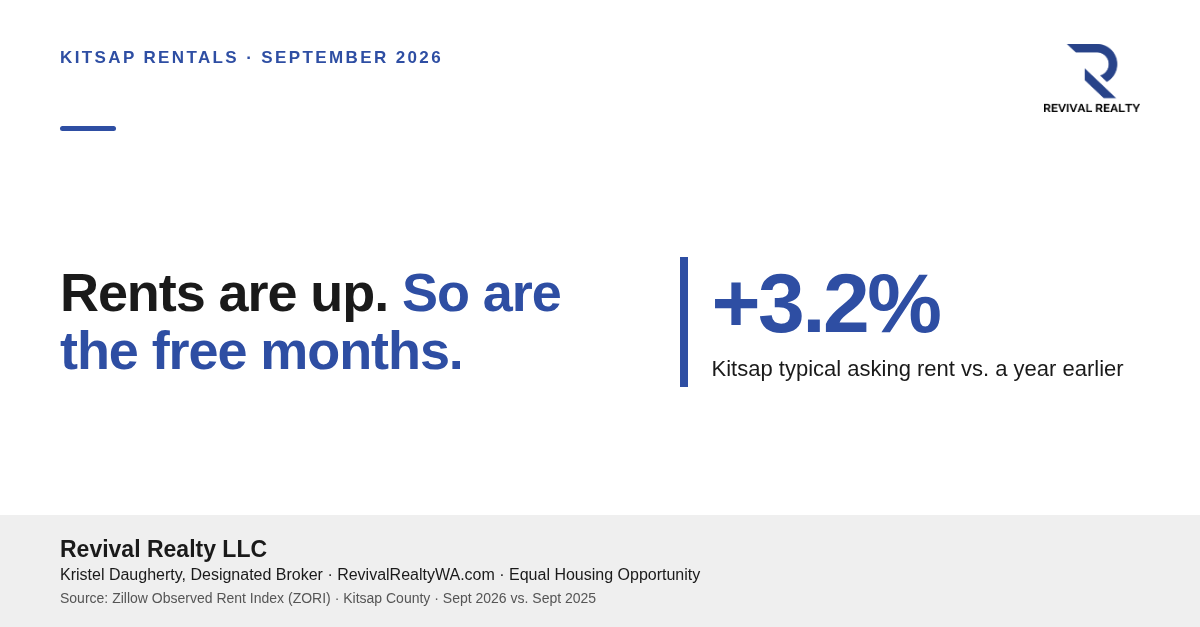
Kitsap’s typical rent was $2,052 in September by Zillow’s measure, up 3.2% from a year earlier — faster than both the national 2.7% and the Seattle metro’s 1.8%.
| September 2026 | Typical rent (Zillow ZORI) | Change from a year earlier |
|---|---|---|
| Port Orchard | $2,006 | Up 4.5% |
| Silverdale | $2,093 | Up 2.6% |
| Bremerton | $1,879 | Up 2.6% |
| Kitsap County | $2,052 | Up 3.2% |
| Seattle metro | $2,250 | Up 1.8% |
| United States | $1,932 | Up 2.7% |
Apartments tell a quieter story. The Washington Center for Real Estate Research put Kitsap’s average apartment rent at $1,803 in the second quarter, up just 0.7% from a year earlier, with vacancy at 4.8% — a full point lower than a year before. Zillow’s index includes rented houses, and single-family rents have been rising faster than apartments nationally, which likely explains much of the gap. Different trackers count differently, too: Kidder Mathews’ second-quarter report had Kitsap apartment vacancy at 7.0%, down from 7.9%. The direction agrees even where the levels don’t.
What doesn’t exist yet is a concession figure for Kitsap. Zillow’s rent reports break out concession shares only for the 50 largest metros, and the Bremerton-Silverdale-Port Orchard metro isn’t one of them. The closest real number is the Seattle metro, where 52.5% of Zillow rental listings offered a concession in July, the latest month Zillow broke out by metro — compared with 39.8% nationally that month. Whether Kitsap looks more like Seattle or more like its own tighter self is genuinely unknown, and anyone who tells you otherwise is guessing.
The region and the state: softer next door, capped statewide
Across the water, the Seattle metro’s rent growth has been slower and its concessions heavier. Kidder Mathews put Puget Sound apartment vacancy at 6.7% in the second quarter. Statewide, WCRER’s average apartment rent was $1,904, up 1.1% from a year earlier, with vacancy at 5.5%.
The bigger statewide change is the law. Under RCW 59.18.700, a landlord can’t raise rent at all in the first 12 months of a tenancy, and after that can raise it by no more than 7% plus Seattle-area inflation or 10%, whichever is less, in any 12-month period. The Department of Commerce set that cap at 9.683% for 2026 and 10% for 2027. The Attorney General’s office says increases require at least 90 days’ written notice. Some tenancies are exempt under RCW 59.18.710 — including units whose first certificate of occupancy is 12 years old or newer, and certain owner-occupied situations such as an ADU or an owner-occupied duplex to fourplex — but those owner-occupant exemptions don’t apply if the owner is a REIT, a corporation, or an LLC with a corporate member. The cap doesn’t limit resetting rent after a tenant moves out.
Landlords: a concession isn’t the same decision as a rent cut
Run Garrett’s math at Kitsap numbers. A 3.2% raise on $2,052 is about $66 a month. One free month at $2,052 spread over a 12-month lease is about $171 a month — roughly an 8% discount, and about two and a half years of that raise.
That doesn’t make concessions wrong. A vacant month costs you the whole rent, not a twelfth of it. The cap is what changes the math. Once a tenancy starts, you can’t raise rent for 12 months and then only up to the cap, so a permanently lower rent is slow to rebuild. A one-time concession keeps the stated rent intact — but how it’s written into the lease matters, and that’s a conversation for your attorney. Whatever you offer, offer it to every applicant on the same terms and advertise it the same way.
The questions worth asking before you offer a free month: How many days has the unit actually been listed? Would a small price change, cleaner photos, or a flexible move-in date do the same job? What does the concession cost spread across the lease? And does your increase calendar leave you room under the cap and the 90-day notice if you need it later?
Renters and investors: price the rent that actually lands
If you rent and are wondering whether to buy, the honest version is that renting is cheaper month to month for a lot of households right now. Zillow estimates the typical rent takes 26.3% of median income nationally, versus 34.3% for the typical mortgage payment. That gap doesn’t settle the question — how long you’ll stay matters more — but it’s a reason not to rush. It’s also reasonable to ask about concessions on a new lease, even if the answer is no.
If you’re underwriting a Kitsap rental, use effective rent — after any concession — not the asking rent on comparable listings. Assume vacancy at least as high as local trackers show, and don’t project rent growth your future tenants’ leases can’t legally deliver. We go deeper on that in our post on conservative underwriting, which went live October 19.
The asking rent is what you hope for. The rent that lands in your account is the number you can plan around.
Sources
- Garrett Brown, BiggerPockets Investor Brief, “Zillow’s New Market Report Says a LOT” (October 11, 2026): https://www.biggerpockets.com/users/garrettbrownre
- Zillow, “Zillow’s September Market Report shows an early winter in the housing market as newly pending sales fall 8.5%” (October 6, 2026): zillow.mediaroom.com
- Zillow Research, Zillow Observed Rent Index (ZORI) data, metro, county and city files, September 2026: https://www.zillow.com/research/data/
- Zillow Research, September 2026 Rent Report (single-family vs. multifamily rent growth): https://www.zillow.com/research/september-2026-rent-report/
- Zillow Research, July 2026 Rent Report (metro concession shares): https://www.zillow.com/research/july-2026-rent-report/
- Washington Center for Real Estate Research, Washington State Apartment Market Report, 2nd Quarter 2026: wcrer.be.uw.edu
- Kidder Mathews, Q3 2026 Seattle & Puget Sound Apartment Market Dynamics (Q2 2026 data): https://kidder.com/trend-articles/q3-2026-seattle-puget-sound-apartment-market-dynamics/
- Washington State Department of Commerce, HB 1217 Landlord Resource Center (2026 and 2027 maximum increases): https://www.commerce.wa.gov/housing-policy/hb1217-landlord-resource-center/
- RCW 59.18.700 and RCW 59.18.710: 59.18.700 · 59.18.710
- Washington State Office of the Attorney General, Landlord-Tenant (rent stabilization and 90-day notice): https://www.atg.wa.gov/landlord-tenant